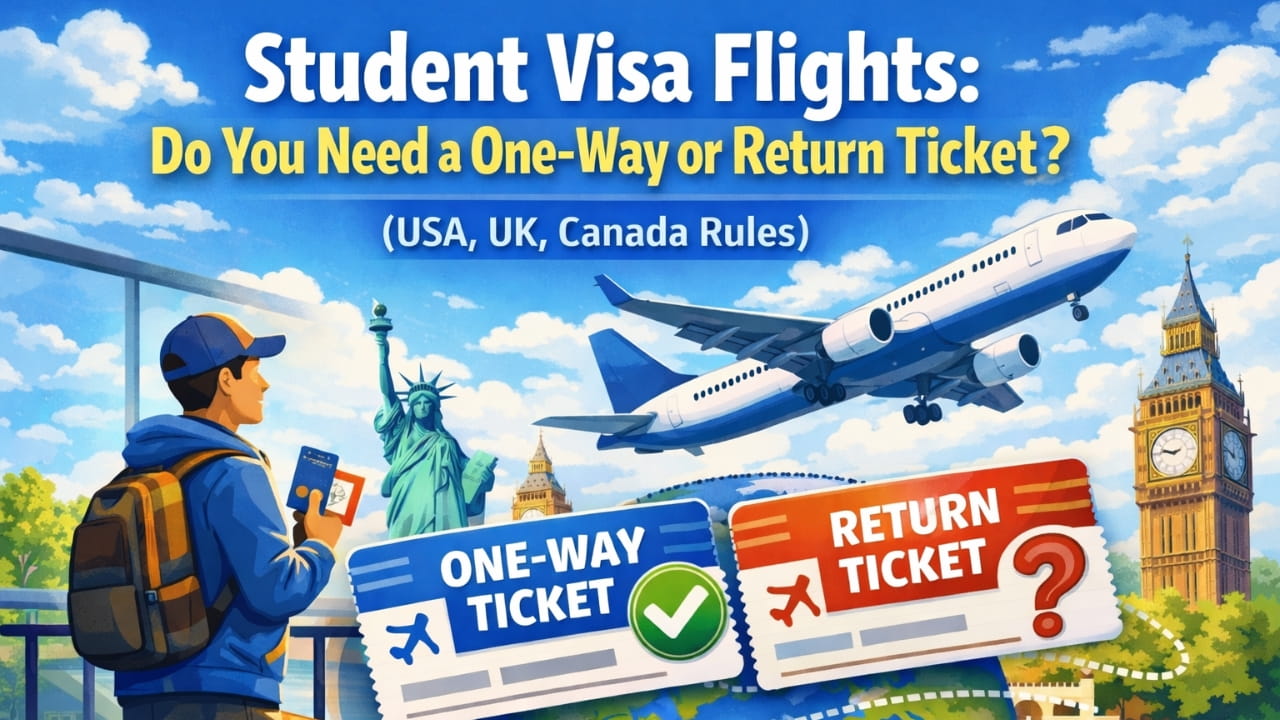
The acceptance letter finally arrived.
You’ve told your family the big news. You’ve celebrated with your friends. You’ve even started a Pinterest board for your new dorm room. It feels real now. You are actually moving abroad.
But then, you sit down to book your flight, and your heart sinks a little. You look at the prices:
- One-Way to London: $600
- Round-Trip to London: $1,300
That is a massive difference. As a student, every dollar counts. You stare at the screen, paralyzed by one terrifying question: "If I buy the cheaper one-way ticket, will they stop me at the airport?"
You’ve heard horror stories. You’ve seen "Border Security" on TV. You know tourists get deported for not having a return ticket. But wait... you aren't a tourist. You are going to live there for three years. Surely the rules are different for you?
The answer is YES, but it’s complicated.
In this guide, we are going to cut through the confusion. We will break down exactly what the Immigration Officers in the USA, UK, and Canada expect from you in 2026, and how to save that $700 without risking your entire future at the departure gate.
The Core Confusion: "Intent" vs. "Status"
Why is this even an issue? It all comes down to how immigration officers view travelers.
For Tourists: You are a "high flight risk." The officer assumes you might try to stay
illegally unless you prove otherwise (by showing a return ticket).
For Students: You have "Resident Status." You have a visa that allows you to live
there for years. The officer knows you cannot possibly book a flight for your graduation date in 2029
because airlines haven't even released those tickets yet!
So, the general rule is: Students on long-term visas DO NOT need a return ticket.
However, you need to prove you have the financial means to buy one later. Let’s look at the specific rules for each major destination.
1. USA: The F-1 Student Visa Rule
Verdict: One-Way is Perfectly Fine.
The US Customs and Border Protection (CBP) officers are strict, but they follow a clear playbook. For F-1 and M-1 students, a round-trip ticket is not a requirement for entry.
What They WILL Ask For
Instead of a return ticket, the officer at the "Port of Entry" (the airport) will ask for your Form I-20.
This document is your lifeline. It proves that your university has vetted you and, crucially, that you have shown proof of funds to cover your tuition and living expenses for at least one academic year.
Even though you are studying for 4 years, the F-1 is strictly a "Non-Immigrant" visa. This means you must intend to leave the US after your studies. If an officer asks, "When are you going home?" do not say "I hope to get a job here and stay forever." That is the wrong answer.
Correct Answer: "I intend to return home after completing my degree to apply my new skills in my home country's market."
2. United Kingdom: The "Student Route" Rule
Verdict: One-Way is Standard (For Long Courses).
The UK Border Force distinguishes between "Visitors" and "Residents."
- Course > 6 Months: You are entering on a Student Route visa. You will pick up a Biometric Residence Permit (BRP) after arrival. You are a resident. One-way ticket is fine.
- Course < 6 Months: You are likely on a Standard Visitor visa or a Short-term study visa. You are a visitor. You NEED a return ticket to prove you won't overstay.
Pro Tip for UK Travelers: Keep your CAS Statement (Confirmation of Acceptance for Studies) handy. It details your course start and end dates. If asked about your return, simply point to the course end date and say, "I will book my return travel closer to this date."
3. Canada: The Study Permit Rule
Verdict: One-Way is Allowed (But Funds are Critical).
Canada is unique. The Canada Border Services Agency (CBSA) officers perform a financial calculation in their heads when you arrive.
They look at your "Proof of Funds" (GIC Certificate or Bank Statement). Let's say you have $20,000 CAD available.
- Scenario A (Return Ticket): You have a prepaid ticket home. The officer sees $20,000 available for rent and food. Result: Approved.
- Scenario B (One-Way Ticket): You have no ticket home. The officer estimates a ticket costs $1,500. They deduct that from your total. They consider you to have only $18,500 available for living. Result: Approved (usually), unless your funds are borderline.
If you fly one-way to Canada, ensure your bank balance is at least $1,500-$2,000 higher than the minimum requirement. This proves you can afford to leave whenever you want.
The Real Problem: The Airline Check-In Agent
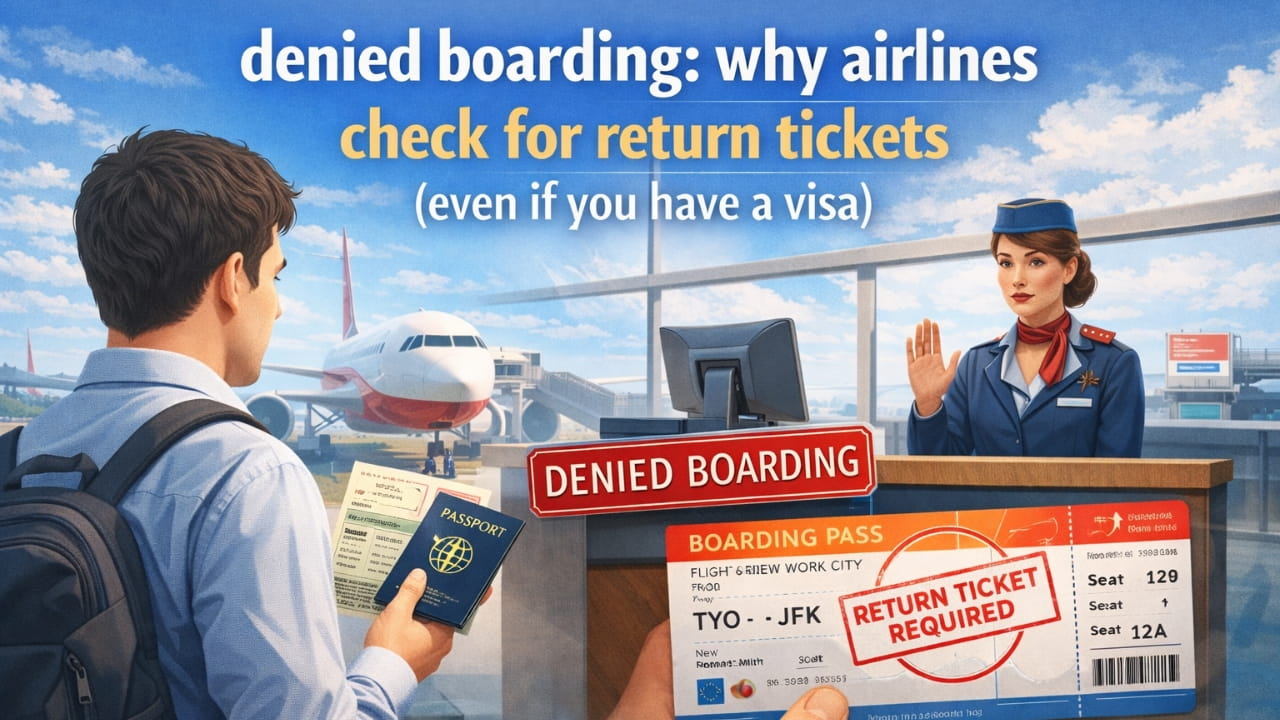
Here is the reality check. The biggest obstacle isn't usually the Immigration Officer in New York or London. It's the check-in agent at your home airport (Mumbai, Manila, Lagos, etc.).
Airlines face massive fines if they fly someone who gets deported. Because of this, check-in agents are trained to be paranoid. They often operate on a simple rule: "No Return Ticket = Denied Boarding." They might not know the intricate details of F-1 or Student Route visas.
Script: How to Talk to a Difficult Agent
If the agent says: "I can't check you in. You need a return ticket."
Don't panic. Say this:
"I understand your policy for tourists, but I am traveling on a long-term Student Settlement Visa. My residency permit is valid for 3 years. According to [Country Name] immigration laws, residents are not required to hold a return ticket. Here is my [I-20 / CAS / Permit Letter] which proves my status."
If they still refuse, ask for a supervisor immediately.
The "Dummy Ticket" Insurance Policy
If you have anxiety about confrontation, or if you are flying a strict budget airline (like Ryanair or AirAsia), there is a shortcut.
You can rent a flight reservation (a "Dummy Ticket") for about $15-$20. This gives you a valid PNR (Booking Reference) that shows a return flight.
- It satisfies the agent instantly.
- It costs a tiny fraction of a real ticket.
- It expires automatically once you land.
Think of it as a $20 "stress-free insurance fee" to guarantee you breeze through check-in.
Summary Comparison Table
| Destination | Visa Type | One-Way Allowed? | Crucial Document |
|---|---|---|---|
| USA | F-1 / M-1 | ✅ YES | Valid Form I-20 |
| UK | Student Route | ✅ YES (Course > 6mo) | CAS Letter |
| Canada | Study Permit | ✅ YES | Proof of Funds (GIC) |
| Europe | Schengen Type D | ✅ YES | Residence Permit Letter |
| Australia | Subclass 500 | ✅ YES | CoE (Confirmation of Enrolment) |
Frequently Asked Questions (FAQs)
1. Can I buy a return ticket with a "flexible" date?
Yes, these are called "Open Return" tickets. However, they are often 2x or 3x the price of a standard ticket. Financially, it is usually smarter to buy a one-way ticket now and a separate one-way ticket home later.
2. Will a one-way ticket affect my immigration interview?
No. As long as you have your university documents (I-20/CAS) and proof of finances, the officer will not penalize you for saving money on flights.
3. What if I am going for my graduation ceremony only?
If you have already finished your course and are just going back for graduation, you are likely traveling on a Visitor Visa (B1/B2 or Standard Visitor). In this specific case, YES, you absolutely need a return ticket.
Final Advice
Moving abroad is expensive enough. Don't let fear force you into buying a $1,200 ticket you don't need. Trust the rules, carry your financial proof documents in your hand luggage (not your checked bag!), and book that one-way ticket with confidence.
Safe travels and good luck with your semester!

Leave a Comment