
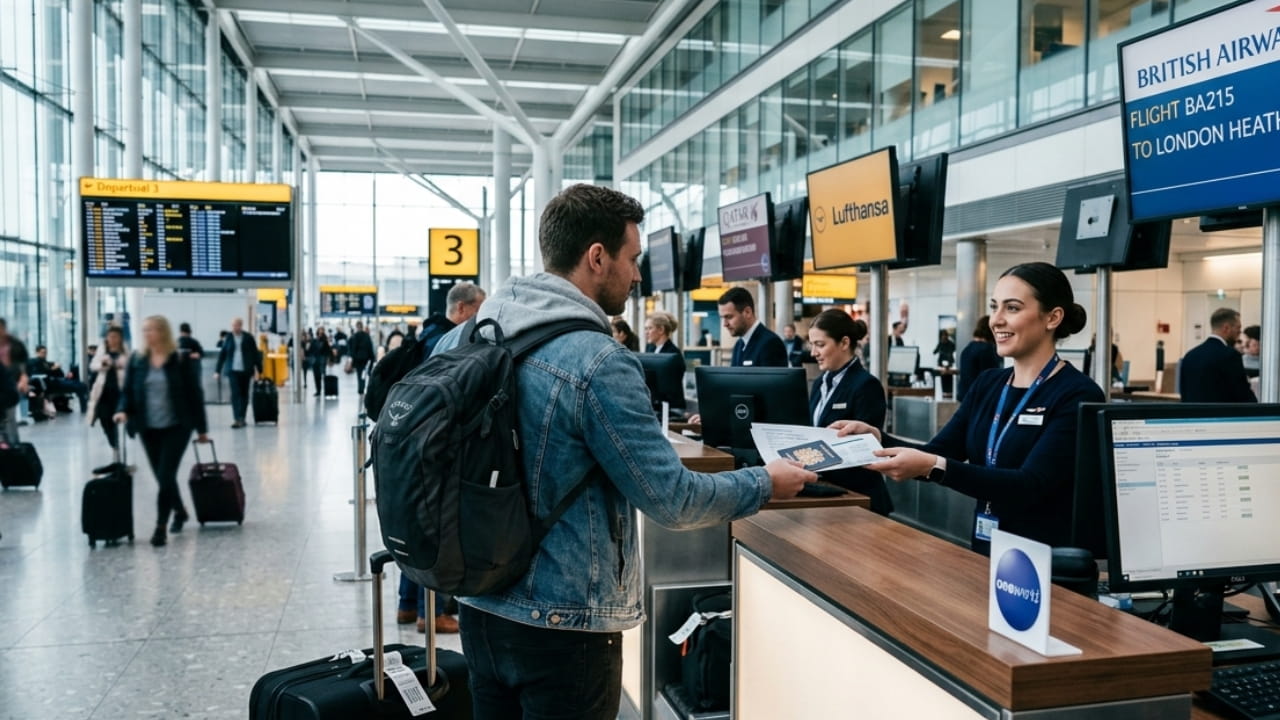
You are at the check-in counter with a valid visa, a packed bag, and a confirmed seat. The agent asks: "Do you have a return or onward ticket?" You have a one-way booking. The agent's screen flags your file. You now have minutes to either prove your exit plan or miss your flight.
This catches Pakistani travelers off guard every year — not at the embassy, not on arrival, but at check-in on the day of travel. This guide explains exactly what proof of onward travel is, why airlines ask for it, which countries require it, and how to get it before you need it.
What Is Proof of Onward Travel?
Most travelers assume immigration and airline checks are about where they are going. Proof of onward travel is about something different — where you are leaving to.
Proof of onward travel is any document confirming you have a plan to exit the country you are entering before your permitted stay expires. It shows an immigration officer or airline agent that you are a genuine temporary visitor with a confirmed departure date — not someone who plans to overstay.
The most common form is a return flight ticket. You fly from Lahore to Bangkok on the 10th and your return from Bangkok to Lahore on the 20th is your proof. The second form is a flight to a third country — Bangkok to Kuala Lumpur on the 20th serves the same purpose. The country you are entering does not care where you go next. It only cares that you leave.
What does not count as proof: a one-way ticket with no documented exit plan, verbal statements about your travel intentions, or evidence of funds without a concrete departure document.
Why Airlines Ask for It — The Carrier Liability Mechanism
Most travelers assume proof of onward travel is a government requirement enforced by immigration. That assumption explains why they get caught off guard at check-in. The real driver is financial — and it sits entirely with the airline.
If an airline carries a passenger who is subsequently refused entry to the destination country, the carrier bears legal and financial responsibility. In most countries, the airline must fly that passenger back at its own cost and may face financial penalties from the immigration authority. This exposure is why airlines run their own checks entirely independent of what any embassy website says.
Airlines use a centralized travel requirements database called TIMATIC to assess each passenger. TIMATIC takes your passport nationality, destination, transit points, visa type, and ticket structure and produces a compliance result. The check-in agent follows that result — not a government website, not what you read online last night. This is why "the embassy didn't mention it" almost never resolves a check-in challenge.
Budget carriers apply this most aggressively. Carriers operating on thin margins into tourism-heavy, short-stay destinations cannot absorb the cost of refused passengers. Many enforce onward travel checks as fixed policy, regardless of the specific country's published immigration requirements.
Why Enforcement Is Inconsistent — And Why That Makes It More Dangerous
Pakistani travelers who have flown internationally multiple times without being asked for proof of onward travel often assume the requirement is theoretical. It is not. It is applied selectively — and that inconsistency is exactly the risk.
Enforcement depends on the check-in agent's training level, the airline's internal compliance culture, and the TIMATIC result for your specific passport-route-visa combination on that day. One agent may wave through a one-way ticket. Another on the same route the same day may flag it.
The three triggers that make enforcement most likely are one-way arrival into a short-stay tourism destination, entry on visa-free or eVisa terms, and a stay duration near the maximum permitted. If two of these three apply to your trip, treat onward proof as mandatory. If all three apply, carry it regardless of what any official website states.
Countries Where Proof of Onward Travel Is Most Strictly Enforced
No single official global list exists. This section is built from immigration enforcement patterns and official government language, verified with primary sources where available. Verify current requirements at the Pakistan Ministry of Foreign Affairs and the official embassy of your destination before travel.
- Thailand: Airlines and immigration consistently request onward proof from one-way ticket holders at Bangkok Suvarnabhumi (BKK). One of the most reliably enforced checks in Southeast Asia.
- Philippines: The Philippines eVisa policy explicitly states "Confirmed tickets for return or onward journey to the next port of destination" are part of the entry requirements.
- Costa Rica: The official Visit Costa Rica website states all non-resident travelers must hold "a return ticket or a ticket as proof of when they intend to exit the country."
- New Zealand: Official immigration guidance states travelers must have "made arrangements to leave New Zealand at the end of your stay."
- USA (Visa Waiver Program): US State Department VWP guidance implies all passport holders must show documented return or onward travel.
- UK: Official guidance requires visitors to prove their status as a "genuine visitor" — evidence of planned departure is one of the cited supporting documents. Pakistani passport holders are regularly asked for onward travel documentation at UK border control.
- Indonesia (Bali): Enforcement at Ngurah Rai International Airport is consistent for one-way arrivals from Gulf and Asian hub connections.
- Japan: Japanese immigration requires a detailed travel itinerary for eVisa applications. Airlines on routes into Tokyo (NRT/HND) check for onward flight documentation.
- Panama, Peru, and Brazil: Enforcement at major international airports and land borders in Latin America is common for one-way travelers.
Pakistan-Specific Routes Where Checks Are Highest
No competitor covers this. Pakistani travelers routing through Gulf hubs to Southeast Asia and the Pacific face check patterns that differ from Western passport holders on the same routes.
- Lahore / Karachi / Islamabad → Dubai → Bangkok: One of the most common Pakistani international routes. Both the outbound carrier and the connecting carrier at DXB may ask for documentation.
- Any Pakistani gateway → Doha → Manila: Philippines immigration and airlines routing into MNL consistently request onward travel.
- Any gateway → Kuala Lumpur (KUL): Malaysia is visa-free for Pakistani passport holders but the one-way arrival check at KUL applies, particularly on budget carrier routes.
- Any gateway → Denpasar (DPS, Bali): Budget carriers routing Pakistani travelers into Bali consistently check for documented exit plans.
Use our Visa Checklist Generator to confirm the full document set for your specific route.
Transit Can Become Entry — The Scenario Most Travelers Miss
Most travelers think about onward travel only for their final destination. They forget their transit can trigger the same requirement for a country they never planned to properly visit.
Your transit becomes a real entry in three specific situations. First: self-transfer on separate tickets. If you book Lahore → Dubai on one ticket and Dubai → Bangkok on a separate ticket from a different airline, you must collect bags, clear UAE customs, and re-check in. You have legally entered the UAE, and the second carrier may ask for onward documentation for the Bangkok leg. Second: overnight or long layovers that force you landside. Third: terminal changes requiring immigration clearance on some routing combinations.
The practical rule is simple. For every stop on your journey, determine whether you stay airside or go landside. Any landside stop — even unplanned — means that country's onward travel requirements apply. Build your documentation around the full route, not just the final destination.
What Counts as Valid Proof of Onward Travel
Not every departure document carries the same weight. Here is exactly what works, what sometimes works, and what does not — at both check-in and immigration.
| Document Type | Status | Where it Works |
|---|---|---|
| Return/Onward Flight (Paid) | Always Works | Every checkpoint, every airline. |
| Verified Dummy Ticket (Live PNR) | Always Works | Visa applications, check-in, border control. |
| Named Ferry or Bus Ticket | Sometimes Works | Land/Sea borders. Rarely accepted by airlines. |
| Fake PNR / PDF Generator | Never Works | Fails verification. Considered document fraud. |
The Visa Application vs The Border Check — Two Different Situations
Most guides treat proof of onward travel as one single concept. It is actually two situations with overlapping but distinct rules — and confusing them causes unnecessary cost and stress.
For a visa application, the flight reservation is a supporting document in your package. Schengen, UK, and UAE embassies use it to assess your travel plan, entry route, and intended duration. The document does not need to be a paid ticket. They assess your travel plan, not your payment.
For boarding and immigration, the check is immediate and practical. A check-in agent needs to see your name, a departure date within your permitted stay, and a destination outside the country — all on one page. A verified PNR reservation passes this because it is checkable on the spot.
How to Get Proof of Onward Travel — 5 Methods Ranked
Method 1 — Dummy Ticket (Best for most travelers)
A verified dummy ticket gives you a real PNR, a professional document format, and zero financial commitment. It works for visa applications, airline check-in, and most border crossings. Order it 1–3 days before your appointment or travel date.
Method 2 — Free Cancellation Booking (US DOT 24-Hour Rule)
Book a refundable exit flight, submit it, then cancel it. US law (14 CFR Part 259.5) requires airlines operating to/from the USA to offer a full refund if cancelled within 24 hours of booking (if booked 7 days prior). This method works if your timing is precise, but is impractical when visa applications take weeks.
Method 3 — Airline Hold Booking Services
Some airlines let you hold a reservation for 24–72 hours before payment for a small fee (e.g., Qatar Airways "Hold My Booking", Emirates "Hold My Fare"). These function identically to dummy tickets but are obtained directly from the airline with a shorter validity window.
Method 4 — Paid Refundable Ticket
Purchase a fully refundable ticket for your exit leg and claim the refund later. The problem: fully refundable fares cost significantly more (often 2–3× the standard price) and refunds take 7–21 business days. A dummy ticket eliminates this heavy upfront cost.
Method 5 — Actual Round-Trip Booking
Simply book a round-trip flight from the start. Your return leg is your onward proof. This is the natural solution when your travel dates are confirmed before you apply. When dates are uncertain, use a dummy ticket as a placeholder.
If You Are Challenged at Check-In Right Now
You are at the counter. The agent is asking for your onward ticket. You do not have one. Here is the exact response protocol:
-
Stay at the counter and stay calm. Ask clearly: "What specific documentation do you need to see?" Stepping away signals you have a problem. Staying engaged keeps the conversation open.
-
Generate a dummy ticket immediately. Generation takes under 5 minutes. Show the agent the document with the PNR. Most experienced agents accept a verifiable reservation.
-
If you have 60+ minutes: Book the cheapest refundable return or onward flight available for a date within your intended stay. Show the confirmation, then cancel using the 24-hour window if applicable after boarding.
-
Ask to speak to a supervisor. Higher-level staff carry more discretion and more experience with non-standard travel patterns.
-
As a last resort, show substantial funds. Proof of significant funds supplements a credible verbal explanation of your exit plan at some borders, though it does not replace onward travel proof.
How to Structure Your Document for Fast Check-In Clearance
Any onward travel document you show at a counter must communicate four things immediately on a single readable page: your full name spelled exactly as on your passport, a departure date falling within your permitted stay, a departure city showing you leave the country you are entering, and a booking reference the agent can run in their system. If any of these four elements is missing, unclear, or inconsistent, expect follow-up questions. A clean dummy ticket or confirmed booking answers all four in the first 10 seconds of review.
Frequently Asked Questions
Proof of onward travel is a document confirming you have a plan to exit a country before your permitted stay ends. Airlines ask for it because they bear legal and financial responsibility if you are refused entry — the carrier must fly you back at its own cost. This carrier liability is why check-in agents enforce it through the TIMATIC database.
It depends on your route and ticket type. If you hold a round-trip ticket, your return leg satisfies the requirement. If you hold a one-way ticket into Thailand, Indonesia, the Philippines, Costa Rica, or similar destinations, treat onward proof as mandatory regardless of whether you have been asked before.
A return flight ticket or an onward flight to a third country — paid or held as a genuine PNR reservation — is always accepted. A verified dummy ticket from a legitimate provider with a real, checkable PNR works at check-in and for visa applications.
At the actual border crossing, sometimes yes. At airline check-in, usually no — airlines verify through the TIMATIC system which cannot validate bus or train bookings. Carry a flight reservation as backup if your exit plan is overland.
At check-in, the agent refuses your boarding pass and you do not board. At immigration, you may be questioned or detained until you produce documentation. Generating a dummy ticket immediately resolves most check-in situations quickly.
Some always do, some rarely do. It depends on the route, the agent, and the TIMATIC result. Budget carriers serving tourism-heavy destinations apply the most consistent checks because they cannot absorb refused passenger costs.
Yes — and it happens regularly. If you cannot produce satisfactory documentation before your boarding deadline, the agent will not issue your boarding pass. Have a dummy ticket ready before you arrive at the counter.
Generally yes. Budget carriers operate on thinner margins and face greater financial exposure from refused passengers. Many apply onward travel checks as fixed policy on high-risk routes regardless of immigration rules.
A digital document on your phone screen is accepted at most check-in counters and borders. Carry a PDF screenshot or email backup in case your phone battery dies. For physical VFS visa applications, always print the document.
Four elements are non-negotiable: your full name exactly as on your passport, a flight number on a real route, a departure date within your permitted stay window, and a booking reference (PNR or ticket number) the agent can verify.
Yes. Once you have entered, the onward travel requirement has served its purpose. You are not legally obligated to board that specific flight. The exception: do not overstay the validity of your visa.
Because the carrier liability risk applies independently. If you are refused entry, the airline may face fines on top of the repatriation cost. That incentive makes airlines apply checks even when official requirements are ambiguous.
Yes — visa-free entry frequently creates a higher check risk, not lower, because your ties to your home country were never formally assessed. Visa-free does not mean document-free.
For a round-trip booking covering all travelers, the single confirmation satisfies the requirement. Where travelers are on separate one-way bookings, each person must have their own documented exit plan with their name on it.
A dummy ticket from a legitimate provider is the lowest-cost option — a small service fee compared to buying a full refundable fare or risking your travel plans. You can generate one in minutes.
Leave a Comment
Your email address will not be published. Required fields are marked *