Imagine this scenario: You are standing at the check-in desk, bag in hand, excited for your holiday. The agent smiles and asks for your ticket. You proudly hand over the printout you got from your travel agent.
The agent frowns. "This is just a booking reference," they say. "I need your ticket number."
Panic sets in. Aren't they the same thing?
In the world of travel, words like "booking," "reservation," and "ticket" sound identical, but to an airline computer, they mean completely different things. Getting them confused can range from a minor annoyance to a rejected visa application.
But don't worry. We are going to strip away the confusing jargon and explain the difference between a PNR and an E-Ticket in plain English, so you never feel lost at the airport (or embassy) again.
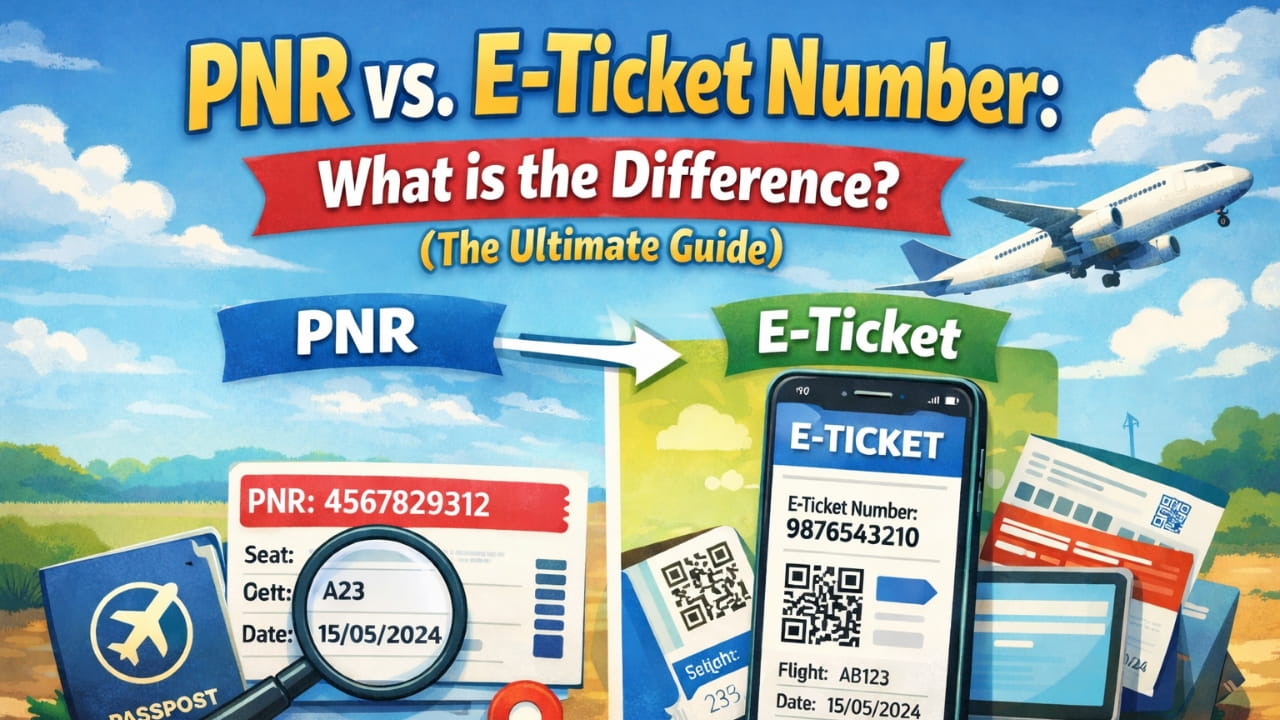
What is a PNR? (The "Digital Folder")
Think of a PNR (Passenger Name Record) like a restaurant reservation. When you call a restaurant and say, "I'd like a table for two at 8 PM," the hostess writes your name in the book. That entry is your PNR.
It means the system knows you exist. It holds your spot. But—and this is the critical part—it doesn't mean you have paid for your meal yet.
How to Spot a PNR
A PNR is almost always a short code made up of 6 random letters and numbers. It looks like a secret spy code: H6J9K2 or R4Z1M9. Airlines might label it on your email as:
- Booking Reference
- Reservation Code
- Record Locator
Why Do Airlines Use It?
This little code is actually a powerful digital folder. It connects you to the global airline network and holds all your personal preferences:
- Your Itinerary: Where you are going and when.
- Your Contact Info: Email and phone number.
- Special Requests: "Vegetarian meal," "Wheelchair assistance," or "Aisle seat."
Because a PNR is just a "reservation," you can have a valid PNR without having a paid ticket. This is exactly what a "Dummy Ticket" is. It acts as proof that you have a flight plan reserved, which satisfies visa embassies without forcing you to risk money on a non-refundable ticket.
What is an E-Ticket Number? (The "Financial Receipt")
If the PNR is the reservation, the E-Ticket is the paid invoice. It is the legal proof that money has left your bank account and the airline has agreed to fly you.
Going back to our restaurant analogy: The E-Ticket is the bill you pay at the end of the night. It confirms the transaction is complete.
How to Spot an E-Ticket
You can't miss it because it's long. An E-Ticket number is always a 13-digit string of numbers (e.g., 176-1234567890). It never contains letters.
The first three digits are a special "accounting code" that tells you which airline sold the ticket:
- 176: Emirates
- 016: United Airlines
- 001: American Airlines
- 125: British Airways
Why You Need It to Fly
Here is the golden rule of air travel: No Ticket Number, No Boarding Pass.
You can have a confirmed PNR. You can have a seat assigned. But if the check-in agent cannot find a 13-digit ticket number linked to your name, the system treats you as "unpaid," and you will not be allowed on the plane.
Comparison: PNR vs. E-Ticket
Still confusing them? Here is a simple cheat sheet to remember the difference.
| Feature | PNR (The Reservation) | E-Ticket (The Receipt) |
|---|---|---|
| Format | 6 Characters (e.g., A1B2C3) | 13 Digits (e.g., 176-1234567890) |
| Purpose | Holds your travel details & preferences | Proves you paid for the seat |
| Used For | Managing your booking online | Refunds, Insurance Claims & Boarding |
| Can Exist Alone? | Yes (Unpaid Reservation) | No (Must always be linked to a PNR) |
The Visa Application Trap
This is where thousands of travelers get confused every year. If you are applying for a Schengen, US, or UK visa, the embassy asks for "Proof of Transport."
But wait! They also warn you: "Do not buy a fully paid ticket until your visa is approved."
So, what are you supposed to submit? They want the PNR.
Visa officers understand the risk of visa rejection. They don't expect you to have a 13-digit E-Ticket yet. They simply want to verify your PNR in their system to see:
- Is the flight real?
- Is the applicant's name on the reservation?
- Is the reservation active (not cancelled)?
This is why services like ours are so popular. We create a verifiable PNR for you that allows the visa officer to check your flight details online, satisfying the requirement without you spending $1,000 on a ticket you might not use.
Troubleshooting: "Help! I'm Confused"
Here are some common real-world scenarios travelers face and how to fix them.
Scenario 1: "I have a PNR but no Ticket Number."
If you are flying today: This is bad. It means your payment didn't go through, or your travel agent hasn't finalized the booking. Call the airline immediately.
If you are applying for a visa: This is perfect! You have a reservation (PNR) without the financial risk. Submit this document.
Scenario 2: "I lost my E-Ticket email."
Don't panic. You don't actually need the physical E-Ticket paper to fly. As long as you have your passport and your PNR code, you can go to the check-in counter. The agent will pull up your ticket electronically.
Scenario 3: "The website asks for a Booking Reference."
That is just another name for PNR. Enter your 6-character code (e.g., H6J9K2) and your last name.
A Final Warning on Security
Your PNR is like a password to your travel plans. If you post a photo of your boarding pass on Instagram to show off your vacation, hackers can zoom in on that PNR code.
With just your last name and PNR, a stranger can log into the airline's website and:
- Cancel your return flight.
- Change your seat to the worst spot on the plane.
- Steal your frequent flyer miles.
Treat your PNR like a credit card number. Keep it private!
Summary
Travel is stressful enough without worrying about codes. Just remember this simple rule:
- Use the PNR to manage your booking, select seats, or apply for a visa.
- Use the E-Ticket only if you need to prove payment or request a refund.
Safe travels!


Leave a Comment